Heating equipment caused an estimated 32,200 home fires in 2021, and the small plug-in heater under your desk is the piece of it most likely to kill someone. The three feet of clearance around it, the outlet behind it, and the habit of turning it off decide the outcome. Below are the fire data, the placement and outlet rules the federal agencies actually publish, and the operating rhythm that keeps a $40 appliance from becoming the worst night of your year.
On a January evening, the math in most houses is simple. The thermostat says 66, the couch sits near a drafty window, and a space heater the size of a breadbox gets plugged in beside the drapes. The U.S. Fire Administration counts heating as the second leading cause of home fires in the country, behind only cooking, even though heating fires have trended downward since the early 1980s. The USFA’s heating fire safety page puts the 2021 toll at an estimated 32,200 reported home heating fires, with 190 deaths, 625 injuries, and $442 million in property loss. That combination, a huge number of fires and a disproportionate share of the deaths, is what makes the topic worth an afternoon. What follows is the fire data broken down, the clearance and outlet rules the federal agencies publish, what certification to a standard like UL 1278 buys you, and the operating rhythm that keeps a small appliance from becoming a midnight emergency call.
In this article
What the Fire Data Actually Says
The 2021 figures from the USFA break into a pattern worth understanding before you buy anything. Home heating fires killed an estimated 190 people that year and injured 625 more, with $442 million in property loss. The category has stayed roughly flat for two decades even as smoke alarms spread through nearly every American home, which makes the next number the one to watch. Portable heater fires were only 3 percent of all home heating fires annually across 2017 to 2019, yet they accounted for 41 percent of fatal heating fires in homes, according to the same USFA data. In other words, the little box on wheels is not the most likely thing in your house to catch fire; it’s the most likely one to catch fire while you’re asleep in the same room and can’t react in time.
That 3-to-41 gap has a straightforward explanation, and it’s the reason the rest of this article keeps returning to placement. A furnace lives in a closet with nothing combustible inside it, tied to a chimney or vent that carries heat out of the house. A portable heater, by design, sits in the middle of your living space, surrounded by the things you own in quantity. Upholstery, drapery, bedding, papers, a Christmas tree in December. When something on or near it ignites at 2 a.m., the person most at risk is the one asleep twenty feet away, because the CDC notes that people who are sleeping can die of poisoning or smoke before they ever register a symptom.
Portable heaters cause 3 percent of home heating fires and 41 percent of the fatal ones. Nothing else in the data carries that kind of ratio.

The Three-Foot Zone, Mapped
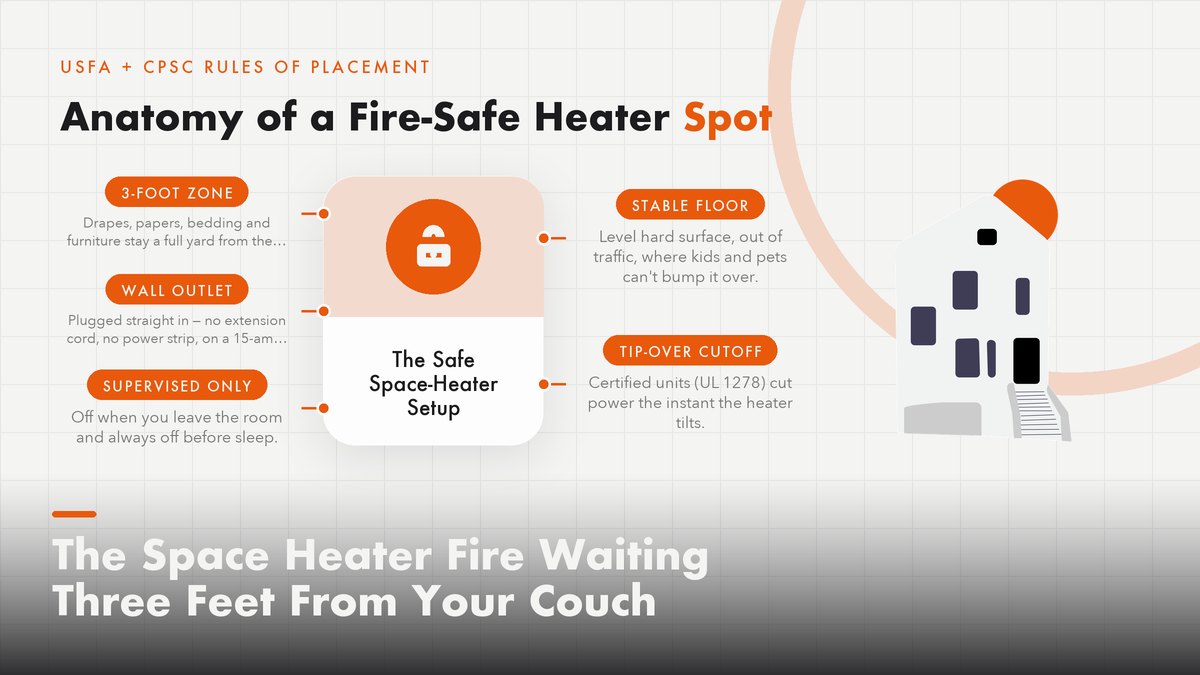
Both the USFA and the Consumer Product Safety Commission publish the same first rule, and it’s the one most households fudge within a week. Keep anything that can burn at least 3 feet from all heat sources, including fireplaces, wood stoves, radiators, space heaters, and candles. The CPSC’s home electrical safety checklist (Pub. 513) names the usual suspects explicitly, drapes and newspapers, and adds the failure mode people forget, which is that nothing should be able to fall or lean onto the heater. A curtain hem billowing in the draft from a hallway, a blanket sliding off the back of a couch, a newspaper dropped beside the chair. The rule isn’t about where things are when you plug the heater in; it’s about where they’ll be two hours later when nobody’s watching.
The checklist’s remaining questions are the ones that catch a heater past its prime. Is the unit stable, on a surface where children, animals, or blowing drapes can’t tip it? Is it in good working order, with no odd smells, sparks, or smoke when it runs? Those three symptoms, odd smell, spark, smoke, are the CPSC’s replace-it-now list. They matter more on a five-year-old heater that’s been dragged between rooms and dropped than on a new one still in its first winter. And if the answer to the seal question is no, the checklist’s instruction is to replace the heater outright. The seal means a listing mark from a nationally recognized testing laboratory such as UL, ETL, or CSA, and an uncertified unit has no business running in an occupied room at all.
- Measure the zone in every direction. Three feet isn’t just the front grille; it’s the back and sides too, since the housing of a running heater gets hot enough to scorch whatever leans against it.
- Pick the surface before the spot. Choose a level, hard floor such as tile, sealed wood, or the low-pile carpet the maker allows, and keep it out of the traffic path, since a tabletop crowded with papers or a windowsill is where units get knocked.
- Treat the doorway as off-limits. A heater in a doorway blocks your exit if it tips and ignites, and the NFPA’s heating safety guidance is blunt about keeping escape paths clear.
- Keep it away from water. The CPSC checklist treats bathroom and kitchen outlets as GFCI territory for good reason; a portable heater doesn’t belong near a tub, sink, or wet floor at all, whatever the circuit protection.
- Re-check after anyone cleans or rearranges. The zone you set in October is gone by January if a throw blanket migrated to the sofa arm.
The Outlet Question Most People Get Wrong
Almost every plug-in space heater sold in North America tops out at 1,500 watts on its high setting, usually with a 750-watt low, and that number is the whole electrical story. A standard household circuit is 15 amps at 120 volts, which works out to 1,800 watts of capacity, and electricians treat a load that runs for hours as a continuous load that shouldn’t exceed 80 percent of the circuit, roughly 1,440 watts. A 1,500-watt heater is already at or past that ceiling on its own, which is why the CPSC checklist’s space-heater section and every fire-safety agency say the same thing. Plug it straight into a wall outlet, never an extension cord, never a power strip, never a two-prong adapter. The cheap multi-outlet strip rated for 1,800 watts total has thin internal contacts that overheat right when a resistive heater pulls its maximum for three straight hours. The 750-watt low setting exists partly for small rooms where you want margin, since it leaves the circuit nearly half free.
That math also settles the “can I run two heaters” question, which comes up in drafty older houses every winter. Two 1,500-watt units draw 3,000 watts together, which is two separate 15-amp circuits at minimum, and in practice it means one heater per room, each on its own wall outlet, with nothing else meaningful on either circuit. If a breaker trips while the heater runs, the right response isn’t a bigger breaker; it’s a different outlet on a different circuit, because the 15-amp breaker just did the one job it exists to do. Once a season, after the first hour on a cold night, run a hand along the plug. A plug that’s warm is normal, but one that’s hot enough to make you pull back, or that shows brown marks on the blades, means the outlet’s contacts are worn. An electrician’s service call runs a fraction of what the alternative costs.
If Your Heater Burns Fuel, the Rules Multiply
Kerosene and other liquid-fuel heaters follow a different rulebook from plug-in electrics, and the carbon monoxide column is the reason. The CDC’s carbon monoxide poisoning page counts more than 400 American deaths a year from unintentional CO poisoning not linked to fires, over 100,000 emergency department visits, and more than 14,000 hospitalizations, with gas- and oil-burning appliances among the named sources. CO is odorless and colorless, the symptoms, headache, dizziness, weakness, nausea, chest pain, confusion, read like the flu. People who are asleep can die before they feel anything, which is why a fuel-burning heater running overnight is the one scenario this article keeps returning to. Even a kerosene heater that’s burning correctly produces some CO, so the manufacturer’s ventilation instructions aren’t a suggestion, only 1-K grade kerosene should ever go in the tank, and the fuel itself gets stored outdoors, away from the house.
Depending on where you live, a kerosene heater may not be an option at all. Many jurisdictions ban unvented fuel-burning heaters in homes, and apartments usually prohibit them by lease, so check before you buy one. Whatever the local rules, the CDC’s prevention advice and our own guide on carbon monoxide basics agree on the non-negotiable layer, which is a working CO alarm on every level of the house, tested monthly, with the bedroom level covered first. An electric heater has no business producing CO; if a fuel-burning one is in the room, the alarm is what catches what your nose can’t.

What Certification to UL 1278 Actually Buys
The seal on the back of a certified heater points to an actual standard with actual contents. UL 1278, titled Movable and Wall- or Ceiling-Hung Electric Room Heaters, is the standard behind most certified plug-in room heaters sold in the U.S.; Edition 4 was published on March 21, 2014, the document is still active, and the most recent revision is dated May 29, 2025, per the UL Standards catalog page. Among the safety provisions the certification testing covers is tip-over protection, the switch that cuts power the moment the unit tilts past vertical. That’s the feature that saves you when the cat jumps on it at 2 a.m. ETL and CSA marks are equivalent in standing, and the CPSC checklist groups all three under nationally recognized testing laboratories because they perform the same third-party testing role. One nuance is worth knowing. The standard’s title covers wall- and ceiling-hung units too, but those are designed to be fixed in place by their mounting hardware, and a portable unit should never be propped on a shelf or hung from anything the maker didn’t specify.
What certification doesn’t do is make a cheap heater pleasant to live with, and that’s where the honest comparison between the three common designs comes in. Retail prices move around with the seasons, usually somewhere between $30 and $120 depending on type and wattage, but the differences that matter for safety and comfort are stable from year to year.
| Type | How it heats | Safety notes | Trade-off |
|---|---|---|---|
| Ceramic fan-forced | Fan blows air across a heated ceramic plate | Fast tip-over response; hot grille at the outlet | Noisy; stops heating the moment the fan dies |
| Oil-filled radiator | Electric element warms sealed oil, which radiates | Surface runs hot for an hour or more after unplugging | Slow to warm a room; silent |
| Infrared (radiant) | Heats objects and people in line of sight | Element gets very hot, needs the widest clearance | Great under a desk; does little for air temperature |
Two features are worth paying for regardless of type. A tip-over switch, which certification to UL 1278 should already guarantee, and an overheat shutoff, which kills power when internal temperature passes the design limit. A thermostat you can actually set is the third, less for safety than for the habit it enables, because a heater cycling on and off unattended overnight is the scenario the next section is about removing. Whatever you buy, retire it the moment the cord stiffens, the plug discolors, or the CPSC’s replace-it symptoms show up, which means odd smells, sparks, or smoke at any point in a heater’s life, regardless of what you paid for it.
The Operating Rhythm That Prevents the Fire
The single highest-value habit costs nothing. Turn the heater off when you leave the room, and turn it off before you go to bed. That’s USFA’s language nearly verbatim, and it’s the rule that closes the gap in the 3-percent-versus-41-percent statistic, because the deaths cluster in fires that start unattended. The operating window that remains, heater on while you’re awake and in the room, works because a person who smells hot dust or sees smoke reacts in seconds. A smoke alarm waking you from deep sleep costs you minutes you may not have. If the bedroom is the cold room in your house, the better fixes are insulation, weatherstripping, or an electric blanket unplugged when you get up, not a 1,500-watt appliance running beside the bed all night.
Two rhythms from the federal checklists keep everything else honest. The CPSC recommends walking its home electrical safety checklist every six months, timed to the clock change so you remember it, and the heater section of that checklist is four questions long. The lab seal, the 3 feet of clearance, the stable surface, the working condition. USFA’s guidance adds the annual layer, which is having heating equipment and chimneys cleaned and inspected each year by a professional, and that matters more if a wood stove or fireplace shares the heating load. In between, a monthly thirty-second pass covers what the schedules miss. Press the test button on the CO alarm, look at the heater’s cord and plug for fraying or scorch marks, and glance at what’s accumulated inside the three-foot zone. Then, on the first properly cold night of the season, give the unit itself a once-over before it runs for hours, since months in a closet or garage can mean dust packed against the element and a cord that got kinked in storage.

Folding It Into the Rest of Your House
A space heater is rarely the only heat source in a house that owns one; it’s usually a patch on a draft, a cold bedroom, or an old furnace struggling through January. That means the heater checklist belongs inside the bigger seasonal pass rather than as its own project. Our twice-a-year home safety walkthrough already has a slot for exactly this, and the clock-change timing that the CPSC suggests for its electrical checklist lines up with it. The CO alarm on the bedroom level connects to the placement logic in our carbon monoxide basics guide, and the escape-path question from the three-foot-zone rules is the same one the fire escape plan asks about every room in the house.
Nobody buys a space heater planning to think about it again. It’s a convenience appliance, bought on a cold evening for something like $40, expected to just work, and most of the time it does, which is exactly why the failure mode surprises people. The USFA data says the failures that kill are the ones nobody’s awake for, in the zone nobody measured, on the cord nobody looked at. The whole apparatus of staying safe amounts to maybe ten minutes of attention spread across a heating season. An afternoon of measuring the three feet, one trip to a better outlet on the first cold night, and a switch you flip when you stand up closes most of that gap, and the rest rides on the CO alarm and smoke alarms you already own.
Sources: U.S. Fire Administration, Heating Fire Safety (2021 estimates; reviewed May 4, 2023) and home heating fire statistics 2017–2019; U.S. Consumer Product Safety Commission, Pub. 513 Home Electrical Safety Checklist (July 2008); NFPA, Safety with Heating Equipment; CDC, Carbon Monoxide (CO) Poisoning Basics (updated October 2026); UL Standards & Engagement, UL 1278 Edition 4. Statistics are national estimates; we update this guide as the agencies publish newer figures.