Ask a firefighter where a house fire does the most damage per fire started, and you won’t hear “kitchen.” Garage fires burn past the first alarm more often, hurt more people, and cost more per incident than fires that start anywhere else under your roof, and the room itself is the reason. This is the one-afternoon tour that takes yours from fuel depot back to parking spot.
Count the hazardous things you store in your garage and the number climbs past anything the kitchen keeps under the sink. A five-gallon can of gasoline for the mower, two propane cylinders left over from summer, oil-based paint from the hallway remodel, and a rack of power tool batteries charging on a workbench, all sharing the air with a car that drips oil onto concrete. The U.S. Fire Administration’s guidance on basement and garage fire safety opens from exactly this picture, and its first storage instruction is blunt: oil, gasoline, paints, propane, and varnishes belong in a shed away from the house. Most of us read that sentence and close the tab, because a shed is a project and the garage shelf already exists. That gap is what this article is for. You don’t need a shed by Friday, but you do need to know which risks in that room actually burn houses down, which ones you can leave alone, and what the twenty-minute version of each fix looks like. Everything here comes from fire incident data and the agencies that collect it, rather than a worst-case mood.
In this article
- Why Garage Fires Out-Damage Every Other Room
- The Shelf of Fuels: Gasoline, Paint, and Propane
- The Car, the Water Heater, and the 18-Inch Rule
- The Newest Garage Hazard Arrives on Two Wheels
- The Wall, the Door, and the Ceiling Between You and It
- The Biggest Moving Object in Your House
- The Twenty-Minute Garage Pass
Why Garage Fires Out-Damage Every Other Room
The national numbers are older than they should be, yet nothing since 2013 suggests the pattern moved. Between 2009 and 2011, an estimated 6,600 residential building fires a year started in garages, according to the U.S. Fire Administration’s topical report on residential garage fires. Those fires killed about 30 people a year, injured another 400, and did $457 million in property damage annually, a per-fire bill several times the average house fire. USFA adds that garage fires tend to spread farther and cause more injuries and dollar loss than fires starting in any other area of the home. The garage’s share of all residential fires is small, around 2 percent, but the fires it produces punch far above that weight. The room is built to burn: open framing overhead, a car with fuel lines and a battery in the middle of the floor, and a shelf of accelerants that no one would stack in a living room.
Two findings in that report should shape where you spend your afternoon, and the first one is the calendar. Garage fires peaked in December and January at roughly 10 percent of the annual total each, with a second summer peak in July at about the same share. USFA ties the cold-weather peak partly to electrical malfunctions, which makes sense once you remember what’s running in a January garage: block heaters, battery tenders, space heaters, plus the extension cords that only come out when it’s freezing. The second finding is what’s burning. Electrical failure or malfunction contributed to about 23 percent of garage fires, and a heat source sitting too close to combustibles showed up in 13 percent, usually as a discarded-materials fire. In practice that means rags, boxes, and packaging left near something warm. Neither cause asks for bad luck; both ask for clutter meeting electricity, and both are what a clean shelf and a checked cord can prevent on the days you get to it first.
A garage holds maybe 2 percent of home fires and far more than 2 percent of the damage, because it’s the one room where fuel, electricity, and an exit into the house share the same air.
The Shelf of Fuels: Gasoline, Paint, and Propane
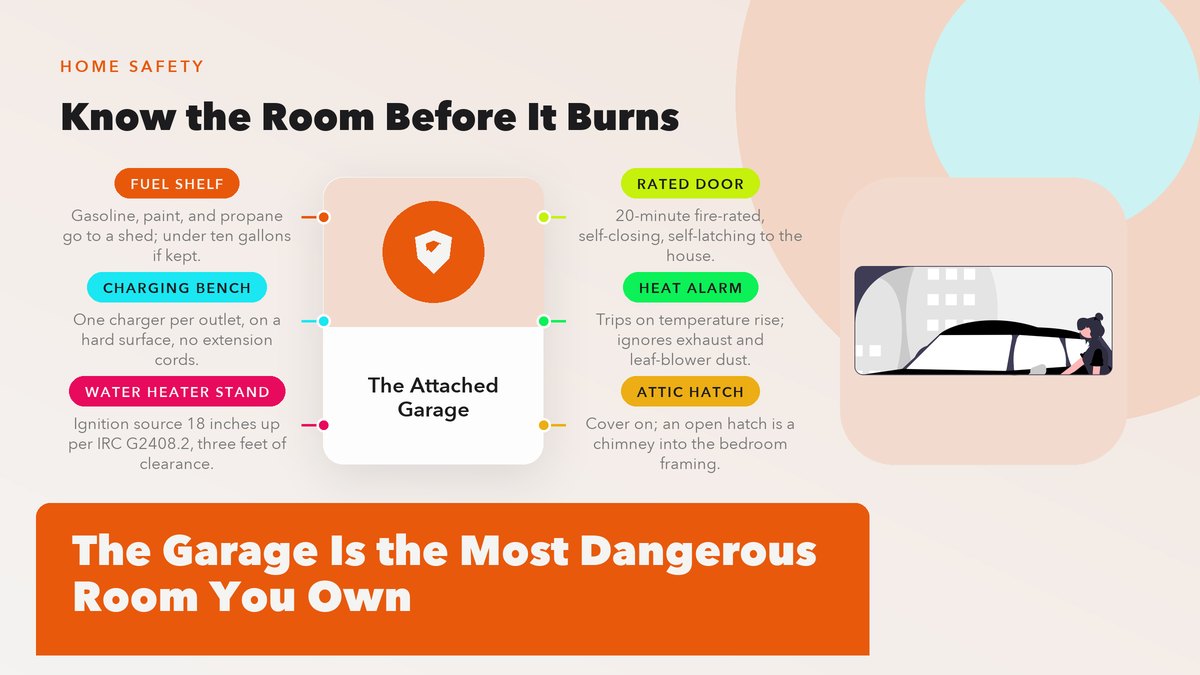
Start with the gasoline, since it’s the most dangerous object in most garages by a wide margin. What actually burns is the vapor, and the liquid only carries it. Gasoline vapor is heavier than air, so it slides along the floor, pools in low spots, and can find a pilot light or a sparking relay twenty feet from the can. That’s why fuel fires so often start somewhere other than where the fuel sits. USFA’s storage rule stays simple: gasoline, along with oil, paint, propane, and varnish, goes in a shed away from the house. If you must keep fuel in the garage over the winter, the compromise version is an approved self-closing container, kept shut, with the total under ten gallons, sitting on a low shelf rather than up high where a leak runs down through everything below it. Oily rags get their own rule because of a failure mode most people have never heard of. Linseed oil, the base of most wiping stains and finishes, heats itself as it dries, and a crumpled pile of rags can smolder into open flame hours after you’ve stopped working. USFA says to keep those rags in an airtight metal container, which runs about twenty dollars at any hardware store, or spread them flat outside to dry before they go in the trash.
Propane earns its own paragraph because it fails differently from the other fuels. A standard 20-pound barbecue cylinder holds a liquid that wants badly to be a gas, and even a small leak in an enclosed garage fills the room’s low corners with something that ignites at a spark. Fire agencies and the propane industry give the same standing rule. Cylinders live outdoors, standing upright, valve closed, with the disconnected hose capped, since an open fitting on a stored cylinder is the classic slow leak nobody smells until the water heater clicks. Propane is heavier than air and pools at floor level, exactly where your furnace, your water heater, and your extension cords all live. If your spare cylinders winter over in the garage now, moving them to the outside wall and chaining them upright against a fence takes ten minutes and a bungee cord, and it removes one entire catastrophe category from the shelf.

The Car, the Water Heater, and the 18-Inch Rule
The classic garage fire that has nothing to do with storage involves a cold engine, a closed door, and carbon monoxide drifting through the shared wall while someone warms the car up for five minutes. Carbon monoxide is odorless, an attached garage feeds it straight into the house through the door seal and the ductwork, and these cases show up in fire department reports every winter, usually under a headline about a family that thought the open door counted as ventilation. It doesn’t. Pull the car out before it idles, even for a minute, and if a bedroom wall shares air with the garage, a CO alarm on that side of the house stops being optional. Our guide on carbon monoxide basics covers alarm placement in detail, and the garage is the most argued-over spot in that whole conversation.
Look up from the car and you’ll usually spot the second half of this section: a gas water heater, sometimes a furnace, sitting on a raised stand. The stand exists because the code requires it. Section G2408.2 of the International Residential Code’s fuel-gas chapter says any appliance with an ignition source in a private garage must keep that ignition source at least 18 inches above the floor, 457 millimeters in the metric column, precisely because gasoline vapor hugs the floor. One exception is worth knowing. Units listed as flammable-vapor-ignition-resistant, the FVIR models that have been standard since the early 2000s, may sit on the floor because they’re tested to survive a vapor event. If your heater predates you, the rating label on the side settles which one you have in about thirty seconds. Either way, keep three feet of clear space around the burner chamber and the flue, and add a painted concrete bollard or a water heater guard if the car has ever kissed the tank backing in, because a dented gas line is the kind of repair that gets expensive exactly when it gets ignored.
The Newest Garage Hazard Arrives on Two Wheels
The fastest-changing corner of garage safety isn’t fuel at all; it’s the charging bench. E-bikes, e-scooters, lawn equipment, and cordless tool batteries all run on lithium-ion packs, and the failure mode is thermal runaway. A damaged or cheap cell overheats, feeds that heat to its neighbors, and the pack can burst into a self-sustaining flame that water doesn’t put out easily. Fire departments now treat these calls as a category of their own. The Philadelphia Fire Department’s lithium-ion guidance for Fire Prevention Week reads like an answer to the average garage: charge big packs like e-bike batteries outside when you can, on a flat dry surface away from sun and rain; use only the charger the manufacturer shipped or approved; unplug at a full charge instead of letting it run overnight on the bench; and never charge on a bed or couch where heat can’t escape. The guidance also makes a buying point that outweighs any single habit. Check for a testing-lab mark like UL before you buy, because the pack that fails at 3 a.m. is usually the no-name one bought on price.
USFA’s garage page adds two electrical rules that predate e-bikes and now apply with extra force: plug only one charging appliance into an outlet, and don’t charge anything through an extension cord. A power strip feeding a battery tender, a block heater, and a trickle charger at once is the January-garage version of the overloaded kitchen outlet, and garage circuits are often shared with outdoor receptacles and the door opener, so one breaker may be protecting more than you think. The bench habits matter as much as the wiring. If a battery or charger shows swelling, a warped case, or a cord that only works when you hold it, stop using it that day and take it to a battery recycling drop-off, because a damaged pack in the trash is a garbage-truck fire waiting for a route. And keep the charging bench on the opposite wall from the fuel shelf, since the room where you’d least like a thermal-runaway event is the one with a gasoline can on it.
The Wall, the Door, and the Ceiling Between You and It
The building code already assumes your garage will have a fire someday, and it treats the room as a small hazard zone that the rest of the house needs armor against. USFA’s construction list is the practical version of that thinking. The door from the garage into the house should be a 20-minute fire-rated door that closes and latches on its own, which is why propping it open with the spring latch disabled ranks among the worst habits in the house. A self-closing door does more work in a garage fire than any alarm you can buy. If you have living space above the garage, the ceiling should be 5/8-inch Type X gypsum board or its equal; the wall where the garage attaches to the house should carry 1/2-inch gypsum; and an attic hatch in the garage needs a cover, because an open hatch is a chimney straight into the framing over your bedrooms. None of this is a remodel list. It’s a know-what-you-have list, and most houses built since the 1980s can be checked in a single weekend afternoon.
One item on that list surprises almost everyone, and it concerns the alarm. USFA recommends a heat alarm in the garage rather than a smoke alarm, because the garage produces smoke that isn’t a fire: exhaust, leaf-blower dust, the first cloud off a cold engine. A smoke alarm in that environment either blares constantly until someone pulls the battery, or it sits there ignored, which is worse. A heat alarm trips at a set temperature rise, ignores your idling car, and only shouts when the room is actually burning. It’s a twenty-dollar device that mounts beside the door you already have, and paired with the smoke and CO coverage in the rest of the house, it means a garage fire gets announced while it’s still a garage fire. If you’ve worked through our twice-a-year home walkthrough, this is the leg most households skip and the data says they shouldn’t.

The Biggest Moving Object in Your House
The garage door gets its own section because it injures more family members than the fire does, and it does it on ordinary Tuesdays. The Door and Access Systems Manufacturers Association calls it the largest moving object in the home, and its safety sheet opens with the fact that carries the most daily weight. An improperly adjusted opener can exert deadly force when the door closes, so the sheet’s first rule is to never stand or walk under a moving door and to stop kids from playing beat-the-door, no matter how funny it looks until the day it doesn’t. The wall button should sit at least five feet off the floor, out of small children’s reach and away from the moving hardware, and the remotes live out of reach too, since a door that answers to a button at floor level is a door a two-year-old can operate.
Two habits cover most of the mechanical risk, and together they take about a minute. The first is the monthly reversal test, straight from the opener manufacturers. Lay a 2×4 flat on the floor in the door’s path, close the door with the button, and watch it reverse the instant it touches the board; a door that crushes the wood or stops without reversing needs its down-force adjusted before anything else uses that door. The second is a glance at the photo eyes, the two sensors near the floor that should stop and reverse the door when the beam breaks, so wipe the lenses and confirm that breaking the beam on purpose reverses a closing door every time. While you’re there, pull the red emergency release once, with the door closed and the household calm, because the night the opener dies with the car inside is the wrong time to learn where the handle is. Check the door’s balance about once a year by disengaging the opener and lifting the door halfway by hand. A balanced door stays put, while an unbalanced one slams, and the spring adjustment that fixes an unbalanced door belongs to a professional. Those springs hold enough stored energy to maim, which is the one garage job the DIY videos shouldn’t talk you into.

The Twenty-Minute Garage Pass
Fold everything above into one pass and it fits in twenty minutes, short enough to run twice a year alongside the rest of the house. Start with the fuels, because they move the most risk per minute: move the propane cylinders outside and chain them upright, cap the gasoline can, and drop the oily rags into their metal can. Then the electricity, meaning one appliance per outlet on the charging bench, no extension cords doing permanent duty, cords intact from plug to equipment, and the block heater unplugged and coiled once January ends. Then the separation: the door self-closes and latches, nothing leans against the water heater, the attic hatch has its cover, and the heat alarm’s test button gets pressed. Finish with the door itself, which means the 2×4 reversal, a wipe of the photo eyes, and a look at the springs and cables for fraying, another call-a-pro trigger. Most households will find two or three items worth acting on the first time through, and nearly all of them cost less than about fifty dollars, which is the pattern that earns the garage pass its slot on the calendar.
| Corner | The pass includes | How often |
|---|---|---|
| Fuel shelf | Gasoline can closed and under ten gallons, propane cylinders outside and upright, oily rags in a sealed metal can | Twice a year, before heating season and before grilling season |
| Charging bench | One charger per outlet, no extension cords, lab-marked batteries only, damaged packs out and to recycling | Every time you plug something in, plus a twice-a-year sweep |
| Appliances | Water heater elevated or FVIR-rated, three feet of clearance, nothing leaning on the flue | Twice a year |
| Separation | Rated door self-closes, attic hatch covered, heat alarm tested | Door monthly, rest twice a year |
| The door itself | 2×4 reversal test, photo eyes, emergency release, spring and cable glance | Reversal monthly, balance yearly, springs to a pro |
None of this turns your garage into a showroom, and it isn’t meant to. The room’s job is to hold the messy half of your life, and a shelf of paint cans behind a closed metal door is a compromise most fire marshals would wave through. What the data asks for is narrower. Fuels that don’t vaporize into a room with a water heater, a door that closes itself, a bench where batteries charge one at a time, and a monthly minute under the biggest moving object in the house. Fix those four and you’ve pulled the most dangerous room you own down to roughly the risk level of the spare bedroom, which is about as good as a room with a car in it ever gets.
Sources: U.S. Fire Administration garage fire statistics and basement and garage fire safety guidance, International Residential Code fuel-gas provisions, DASMA garage door safety guidelines, and Philadelphia Fire Department lithium-ion battery safety guidance.