Most American homes have at least one fire extinguisher somewhere. Almost nobody living in those homes has pulled the pin, read the pressure gauge, or heard what a discharge actually sounds like. That gap between owning a device and knowing how to use it is exactly where small fires stop being small.
Picture the moment a home fire actually starts. A tablespoon of oil in a pan goes past its smoke point while you’re checking your phone in the next room, and by the time you smell it, the pan itself is burning and flames are licking the range hood. You have an extinguisher somewhere behind the winter coats in the hall closet, bought around 2016 as far as you remember. Can you pull the pin one-handed? Do you aim at the flames or at the base of them? Hesitating on either question puts you in the overwhelming majority, and the U.S. Fire Administration’s cooking-fire data shows why that hesitation is expensive. Cooking is, by a wide margin, the leading cause of home fires and home fire injuries in the United States, and in 2021 alone American fire departments responded to an estimated 170,000 home cooking fires that killed 135 people, injured roughly 3,000 more, and caused over $494 million in property loss.
None of that makes the extinguisher itself useless. Used correctly, on the right fire, at the right moment, a portable unit can put out a small fire or hold it down until the fire department arrives, which is exactly what the National Fire Protection Association says it’s for. The problem is everything around the device: most of us bought it once, stuck it out of sight, and never spent the sixty seconds it takes to learn what the letters on the label mean or what the four-step technique is called. This article is those sixty seconds, expanded into everything a household needs, and that difference is what separates a ruined dinner from a 911 call.
In this article
- Why the Extinguisher Is the Most Misunderstood Device in the House
- A Class for Every Fire
- Buying the Right One
- Where to Put It
- PASS: Four Moves, Learned Before You Need Them
- Fight or Flee: The Six Questions That Decide
- The Grease Fire Exception Where the Extinguisher Isn’t First
- Maintenance: The Ten-Minute Habit That Keeps It Alive
- If the Fire Doesn’t Care About Your Plan
Why the Extinguisher Is the Most Misunderstood Device in the House
The first thing to get straight is what an extinguisher is for, because many people believe, deep down, that it’s there to help them fight through a serious fire, and that belief gets people hurt. Fire doesn’t leave time to discover the mistake. According to Ready.gov, a small flame can turn into a major fire in under thirty seconds, a fire can become life-threatening in about two minutes, and a typical residence can be fully engulfed in five. The heat is worse than the visuals suggest, since room temperatures can hit roughly 100 degrees Fahrenheit at floor level and climb to around 600 degrees at eye level, hot enough to scorch lungs and melt synthetic clothing onto skin.
The NFPA’s position on this is unambiguous, and it’s worth reading as they publish it: a portable extinguisher is one element of a fire response plan, but the primary element is safe escape, and the number-one priority for anyone in a burning building is to get out. Smoke and toxic gases, rather than flames, kill most fire victims, which is part of why a room that still looks mostly fine can already be unsurvivable to stand in. An extinguisher covers one specific scenario, a fire that is still small and contained when you reach it, and treating it as anything grander turns a device that could save your kitchen into a reason you stayed too long.
An extinguisher never replaces an escape plan or working smoke alarms. It covers the one narrow gap between “the fire is born” and “the fire is in charge.”
A Class for Every Fire
There is no universal extinguisher because there is no universal fire.
Walk down the hardware-store aisle and you’ll notice the cans carry letter ratings, and those letters are the reason the wrong extinguisher can fail on a fire the right one would kill in seconds. The USFA breaks portable extinguishers into five primary classes, each built around a different fuel. Class A covers ordinary combustibles like wood, cloth, and paper. Class B is for flammable liquids such as gasoline, oil, and oil-based paint. Class C is for energized electrical equipment, meaning appliances and tools that are still plugged in, and its agent is chosen because it doesn’t conduct electricity. Class D, found in factories rather than homes, handles combustible metals like magnesium and titanium. Class K, the commercial-kitchen specialty, is made for vegetable oils, animal fats, and the cooking-appliance fires that restaurant kitchens produce.
| Class | What’s burning | Where you’ll meet it |
|---|---|---|
| A | Wood, cloth, paper, most ordinary solids | Living rooms, bedrooms, garages, wood stoves |
| B | Gasoline, oil, paint thinner, propane | Garages, workshops, grills, fuel storage |
| C | Energized electrical equipment | Appliances, power tools, anything plugged in |
| K | Cooking oils and fats | Commercial kitchens (restaurants, cafeterias) |
| D | Combustible metals | Factories and machine shops |
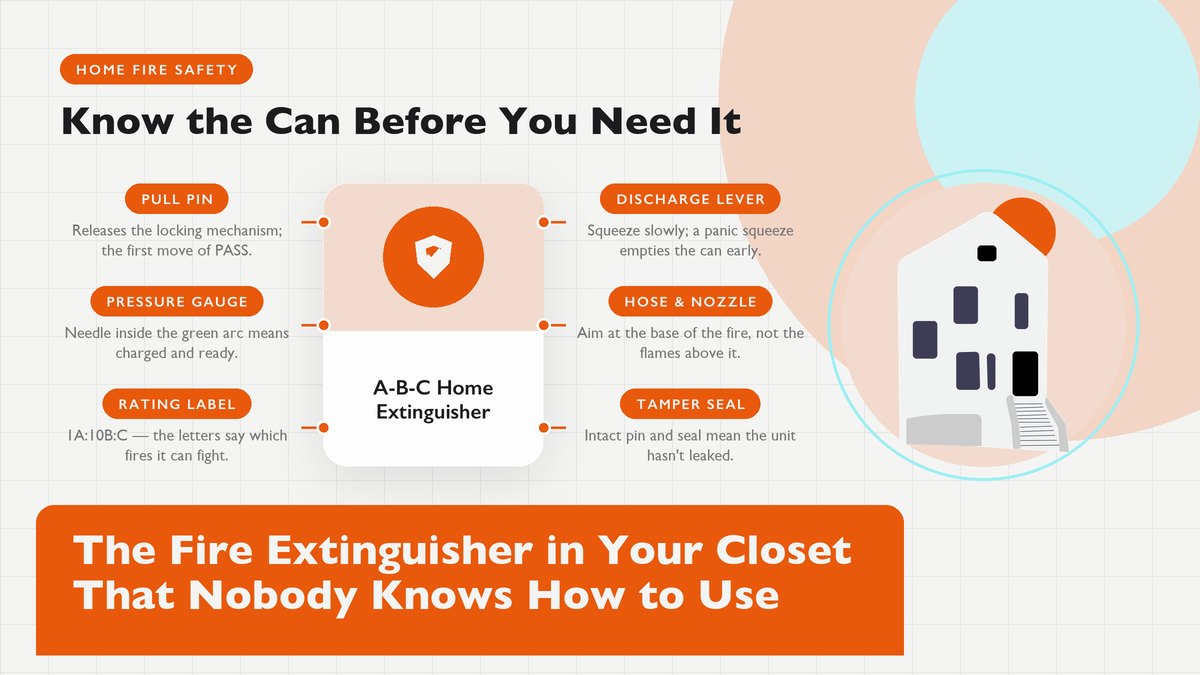
The good news for households is that you don’t need five cans. Multipurpose dry-chemical extinguishers labeled “A-B-C” cover the three classes a home actually produces, and the USFA notes that most home improvement stores carry them as the default. What deserves a closer read is the rating number, because it says how much fire the unit can handle. In the label format “1A:10B:C”, the number before the A means the equivalent of that many times 1.25 gallons of water on a Class A fire, so a 3A rating covers roughly 3.75 gallons’ worth of ordinary-combustible fire. The number before the B is the square footage of liquid fire the unit can knock down, so 10B means about ten square feet of burning gasoline. That 1A:10B:C figure is a real, common rating on small kitchen units, and it’s on the small side, which is why size matters more than most shoppers realize.

Buying the Right One
The USFA’s buying advice comes down to two rules. First, look for a “UL Listed” or “ULC Listed” label, which tells you a nationally recognized testing laboratory has certified the unit performs at its printed rating. Second, buy the largest extinguisher you can comfortably carry and operate, because a unit that’s too heavy to lift one-handed tends to stay on its bracket even when the stove is burning. A half-used, undersized charge on a growing fire mostly costs you the seconds you could have spent leaving.
For most homes that lands on a 5-pound multipurpose dry-chemical unit with an A-B-C rating, the size stocked everywhere from hardware chains to warehouse stores. Workhorse models like Amerex’s B500 and Kidde’s Pro 210 carry a 3A:40B:C rating, which translates to roughly 3.75 gallons of water-equivalent on ordinary combustibles and about forty square feet of liquid fire. A sensible layout is one unit in or near the kitchen and another in the garage, where the fuel changes from cooking oil to gasoline, solvents, and power tools. Rechargeable metal-valve models cost more up front but can be refilled after any use, while sealed plastic-valve disposables are cheaper and simply get swapped out, so your choice depends on whether you’d realistically drive a discharged can to a fire-equipment dealer or let it gather dust in the garage.
Where to Put It
Placement is the decision people get wrong most often, and the mistake is intuitive: the extinguisher goes next to the thing that might catch fire. It doesn’t, and the reason is obvious the moment you picture a grease fire on the stove with flames standing between you and the cabinet beside it. The NFPA’s guidance is to install extinguishers close to an exit and to keep your back toward that clear exit while you use the device, so the moment the fire doesn’t respond you’re already facing the way out. In a kitchen that means mounted by the doorway or on the wall just outside it, never directly beside or above the range. In a garage it means by the man door rather than behind the workbench where the solvents live.
Two more placement rules turn a good plan into a working one. Mount the unit where you can reach it in the dark and with smoke in the room, because that’s the condition it’ll be fetched in, not the bright Saturday afternoon when you installed it. A wall bracket at adult shoulder height, on an unobstructed wall, beats a spot somewhere in the coat closet every single time. And don’t count every level of a multi-story home on one kitchen unit, since a fire on the second floor can cost you the stairs and the extinguisher together; two units near ground-floor exits plus one upstairs, ideally near the top of the stairs, is about the most most households will maintain.
PASS: Four Moves, Learned Before You Need Them
Every fire department and both national organizations teach the same technique, and it’s four letters: PASS. Pull the pin, holding the extinguisher with the nozzle pointed away from you while you release the locking mechanism. Aim low, at the base of the fire where the fuel actually sits, rather than at the flames dancing a foot above it. Squeeze the lever slowly and evenly, since a panicked full squeeze dumps your charge in seconds and empties the can early. Sweep the nozzle side to side across the base, moving forward only as the fire shrinks.
A few details the acronym doesn’t carry make the difference between practice that looks right and practice that works. Keep your back to the exit the NFPA told you to stay near, and open up from somewhere around six to ten feet back, closing the distance as the fire dies; most home dry-chemical units throw a cone that reaches on the order of ten to twenty feet depending on model and charge. Expect a loud discharge and a thick cloud of fine powder that coats the kitchen and makes it hard to see the base you meant to aim at. That powder is also mildly corrosive to electronics, which is one more reason an extinguisher shouldn’t be the first resort on anything you could smother with a lid. And read the operating instructions now, in good light, because the USFA points out that familiarity with the parts is what you build before a fire breaks out.
Fight or Flee: The Six Questions That Decide
The checklist at the center of all of this is the one the USFA suggests running before anyone picks up a can, because an extinguisher is the right answer only when every answer below is yes. Have you alerted everyone else in the building that there’s a fire? Has someone actually called the fire department, from a phone outside the burning room? Are you physically able to operate the unit, standing where you are? Is the fire small and contained to a single object or surface, like one pan or one wastebasket? Are you safe from the fire’s toxic smoke, with breathable air between you and the flames? And is your escape route behind you clear, so retreat doesn’t mean finding the door by memory?

If any answer is no, or if you’re not sure, the instruction from both the USFA and the NFPA doesn’t bend: alert the others, leave the building, close doors behind you to slow the fire, and call 911 from your mobile phone or a neighbor’s house. Two items deserve extra emphasis. The USFA says young children and older adults shouldn’t use fire extinguishers at all, and the NFPA goes further, stating that children shouldn’t even be trained on them, because teaching a kid to fight a fire cuts against the far more valuable lesson of getting out and staying out. And the moment the room fills with smoke, whatever your answers were, the fight is over and the escape starts, because it’s the smoke, rather than the flames you can still see, that kills.
The Grease Fire Exception Where the Extinguisher Isn’t First
The most common home fire in America, the cooking fire, is also the one where your first move shouldn’t be the can at all. If a pan of oil catches fire, the USFA’s own advice is to slide a pan lid or a metal baking sheet over it, turn the burner off, and let the sealed pan cool, since cutting off the oxygen kills a grease fire cleanly while the lid stays between you and the splash. Keep that lid or baking sheet on the counter right beside the stove whenever the burners are on, the same way you’d keep a towel handy for frying, and the fire often ends as a story instead of an insurance claim.
The ways people make a grease fire worse are consistent enough that firefighters can recite them in their sleep. Never pour even a cup of water on burning oil, because the water sinks below the oil, flashes instantly to steam, and launches the burning oil out of the pan in a sheet of fire that hits the wall and you. Don’t try to carry the flaming pan across the kitchen to the sink or, worse, outside, since sloshing oil runs over the rim and down your hands on the way. And skip the flour and sugar, because both are combustible and can flare into a cloud of fire; baking soda works in a pinch precisely because it releases carbon dioxide as it decomposes with heat, but a lid is faster, cleaner, and doesn’t empty a pantry onto the stove. The extinguisher earns its place here as the backup for when the lid doesn’t land or the fire has already jumped past the pan, which is exactly where the “small and contained” line from the checklist comes in. It’s also why the kitchen unit needs a real B rating rather than the smallest A-only can on the shelf.
Maintenance: The Ten-Minute Habit That Keeps It Alive
An extinguisher doesn’t last forever just because you never used it. The USFA’s maintenance list is short enough to run in one pass once or twice a year, and it starts with access: nothing parked in front of the bracket, nothing buried, nothing that’s migrated into a storage box. Check that the pressure gauge needle sits inside the green arc between the two red zones, since a unit that’s drifted low has silently become a decoration. Look the can over for dents and rust, check the hose and nozzle for cracks, and confirm the pin and tamper seal are still intact. Then follow whatever schedule the label specifies, which for some models means a monthly shake to keep the dry chemical from compacting and for others means a professional pressure test every few years.
The last maintenance question is the one people forget: after any use, even a two-second squirt, the unit needs attention. Rechargeable models can be refilled by a fire-equipment dealer, usually for much less than a new can, while sealed disposable units go straight to replacement. If the gauge reads low, if the unit is older than the service life the manufacturer states (commonly around ten to twelve years for metal-valve household units), or if you can’t remember when it was bought, replacement is the sensible answer. And if you’d rather have professional eyes on the whole picture, many local fire departments offer extinguisher training and answer questions through their non-emergency line, which the USFA explicitly encourages people to use.

If the Fire Doesn’t Care About Your Plan
None of this survives contact with a real fire unless a final piece is in place: everyone in the house knows the extinguisher is a side quest and the exit is the main one. That means working smoke alarms on every level, an escape plan with two ways out of every room and a fixed meeting place outside, and a household rule, said out loud, that nobody goes back in for anything. The American Red Cross puts house fires at the top of its disaster-response list precisely because they’re the most frequent disaster Americans face, and the pattern in incident reports is consistent. Someone fights a fire that was already too big, someone goes back inside for a pet or a phone, someone dies of smoke in a hallway two rooms from the door.
So buy the 5-pound A-B-C unit with the UL label, mount it by the kitchen door and another by the garage exit, run the gauge and pin check when the seasons change, and practice PASS once in the yard with an old unit if you can spare one, so the pin pull and the sweep aren’t brand-new motions. Then hold the extinguisher in your mind as what it is: the tool for the first thirty seconds of a fire that never gets big. For everything bigger, the plan is the one it’s always been. Get out, stay out, and let the people with the breathing apparatus do the going back in.
Sources and scope: This guide draws on the U.S. Fire Administration’s fire extinguisher guidance, the NFPA’s extinguisher safety tips, Ready.gov’s home-fire facts, USFA cooking-fire statistics, and the American Red Cross home-fire resources. For the escape side of the picture, see our companion guide on two-minute home fire escape planning. Product examples are illustrative, not endorsements; always follow the instructions for your specific unit.